
Harish Ragul
Rajaramaduraikarthik
Building numerical solvers for incompressible flows and conjugate heat transfer – from FEniCS finite element methods to Navier–Stokes – with a long-term goal of PhD research in thermal management, CFD, and numerical simulation.

Academic Background
Education

M.E. Thermal Engineering
 Anna University
B.E. Aerospace Engineering
Anna UniversityExperience
Professional Experience
Industry work provides deep computational software engineering skills – directly applicable to building research infrastructure and production-grade numerical solvers.

Project Associate I
- ›National Institute of Ocean Technology (NIOT) – Deep Ocean Mission, sponsored by the Ministry of Earth Sciences.
- ›Mathematical modelling, simulation, and experimental verification of underwater rigid body dynamics.

Software Developer – Python
- ›Built and maintained production backend services in Django and Flask: REST APIs, PostgreSQL/MySQL database design, payment integrations, analytics pipelines (Pandas + SQL).
- ›Developed clean, reviewed, production-quality code in an agile team – practices directly transferable to simulation scripting and reproducible research workflows.

Teaching Assistant
- ›Technical Training Engineer at the Drone Innovation Center.
Key Projects
Research & Engineering Work
Each project combines rigorous theory with working implementations – solver code, deployed applications, and open-source contributions.
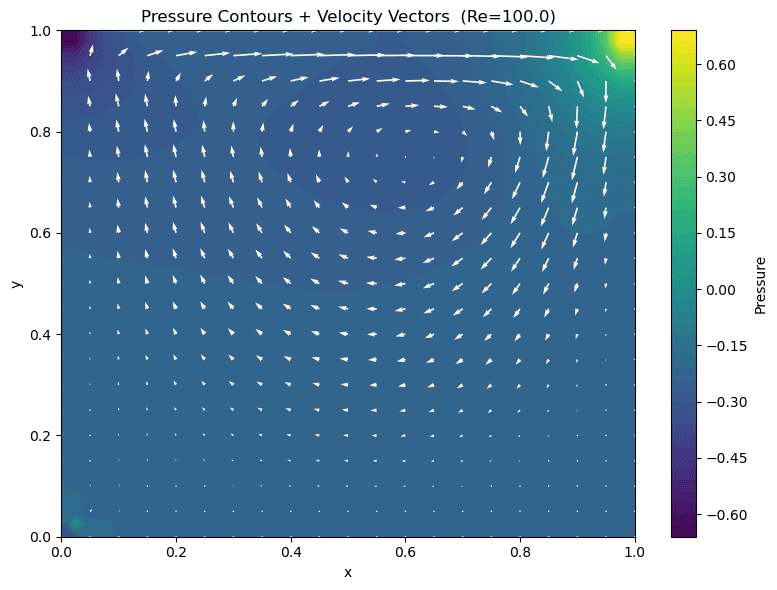
Lid-Driven Cavity Flow: A Python Projection Method Solver Validated Against Ghia et al. (1982)
I have been studying CFD (Computational Fluid Dynamics) from absolute basics like 1D Advection Flow, Diffusion Problems, Burgers Equation. I'm using Python to simulate and solve all these problems myself. From there I worked up to the Navier-Stokes Equation Problem and I studied about the Projection method to solve it. I built a custom solver to simulate the 2D incompressible viscous flow with Projection method. To verify the solver working correctly I chose to solve the Classic Lid-Driven Cavity Problem and compared my results against the Ghia et al. (1982) benchmark data to validate the solver.
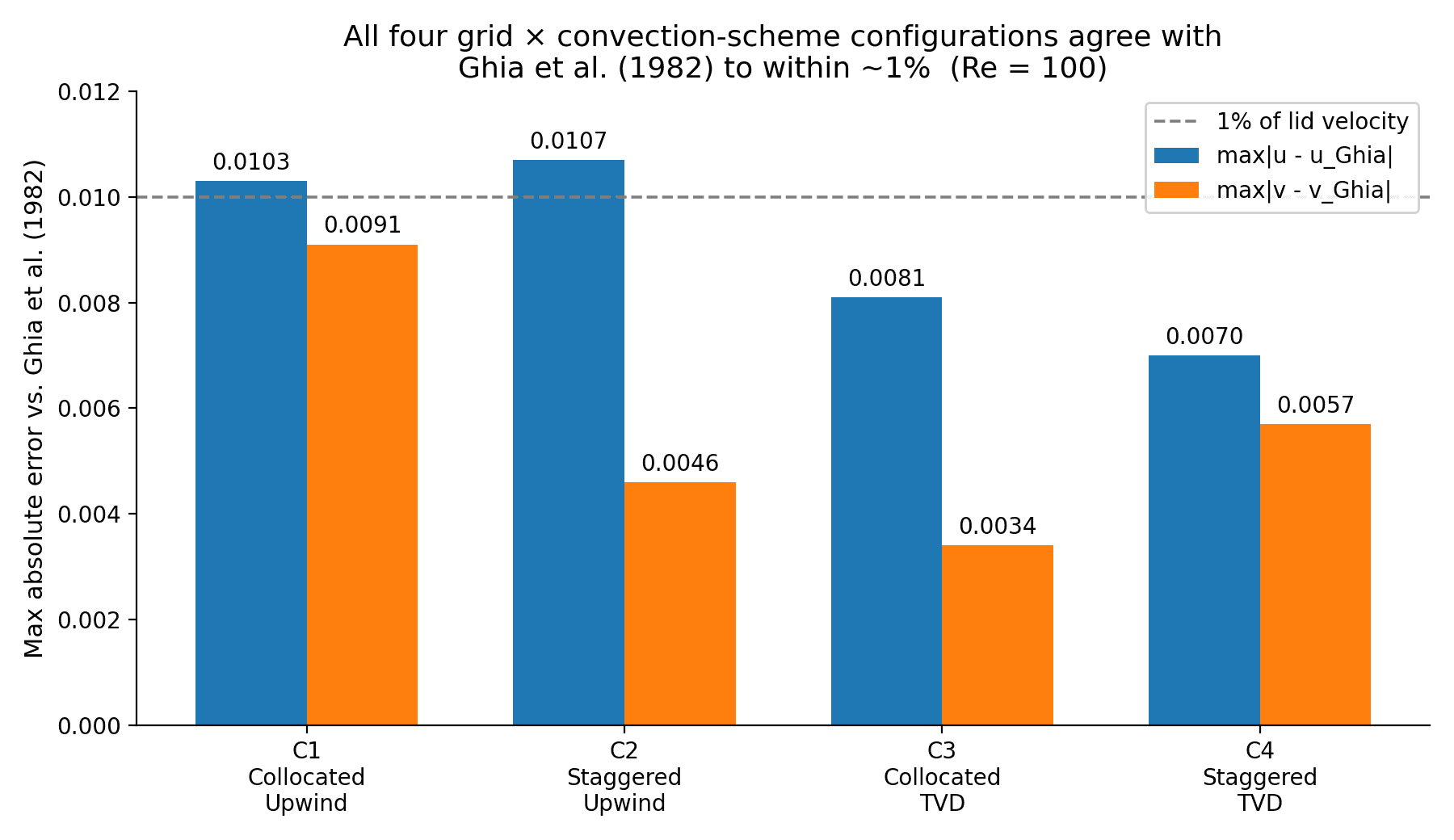
Effects of Grid Arrangement and Convection-Scheme Discretisation on Projection-Method Accuracy for the Lid-Driven Cavity: A Verification Study
A systematic verification study isolating how much of a projection-method solver's accuracy comes from grid arrangement versus convection-scheme discretisation – something most published lid-driven cavity validations don't separate out. I ran a 2×2 comparison (collocated vs. staggered/MAC grid, crossed with first-order upwind vs. second-order TVD Van Leer convection) at Re = 100, validating all four variants against Ghia et al. (1982) using an identical quantitative error metric. All four configurations agree with the benchmark to within about 1% in both velocity components, with TVD improving on upwind in at least one component. A companion 1D screening study compares five convection schemes (upwind and four TVD limiters – minmod, Van Leer, superbee, MC) to give an a priori basis for choosing Van Leer. I also re-examined a collocated-grid TVD configuration I'd previously flagged for pressure-solver convergence difficulty, and found it converges cleanly – producing the lowest v-velocity error of all four configurations tested.
Research Output
Publications
Rajaramaduraikarthik, H. (2026). Lid-Driven Cavity Flow: A Python Projection Method Solver Validated Against Ghia et al. (1982). Zenodo.
doi.org/10.5281/zenodo.20623227Rajaramaduraikarthik, H. (2026). Effects of Grid Arrangement and Convection-Scheme Discretisation on Projection-Method Accuracy for the Lid-Driven Cavity: A Verification Study. Zenodo.
doi.org/10.5281/zenodo.22260108Rajaramaduraikarthik, H. (2026). CFD from Scratch: A Self-Paced Python Course from Finite Differences to Turbulence. Journal of Open Source Education.
jose.theoj.orgTechnical Toolkit
Skills & Tools
Thermal Simulation
- Steady-state & transient heat conduction
- Conjugate heat transfer
- ANSYS Thermal & Fluent (temperature field analysis, BCs, material properties)
- FEM (FEniCS)
- Mixed boundary conditions
- Non-uniform thermal conductivity
CFD & Numerics
- FDM, FVM
- Projection method, SIMPLE
- TVD schemes (van Leer, minmod, superbee, MC)
- QUICK, MUSCL
- Pressure-velocity coupling
Turbulence
- RANS
- k-ε, k-ω SST (Menter 1994)
- Wall functions
- y⁺ estimation
- Turbulent channel flow validation
CFD & Thermal Tools
- ANSYS (Fluent, CFX, Thermal, Structural, ICEM CFD, Workbench, SpaceClaim)
- OpenFOAM (icoFoam, simpleFoam, blockMesh, snappyHexMesh, ParaView)
- FEniCS
- Python/NumPy solvers
Programming
- Python (NumPy, SciPy, Matplotlib, Pandas, Django)
- C/C++ (basic reading & modification)
- Git
- Linux
Writing
Research Notes
Technical notes on solver derivations, numerical methods, and CFD case studies – written to build depth and share understanding.
Get in Touch
Contact
I am actively seeking PhD positions and research collaborations in thermal management, CFD, and numerical simulation. If you work in these areas, I would be glad to connect.