Work
Projects
Research and engineering projects – each grounded in governing equations and implemented as working software.
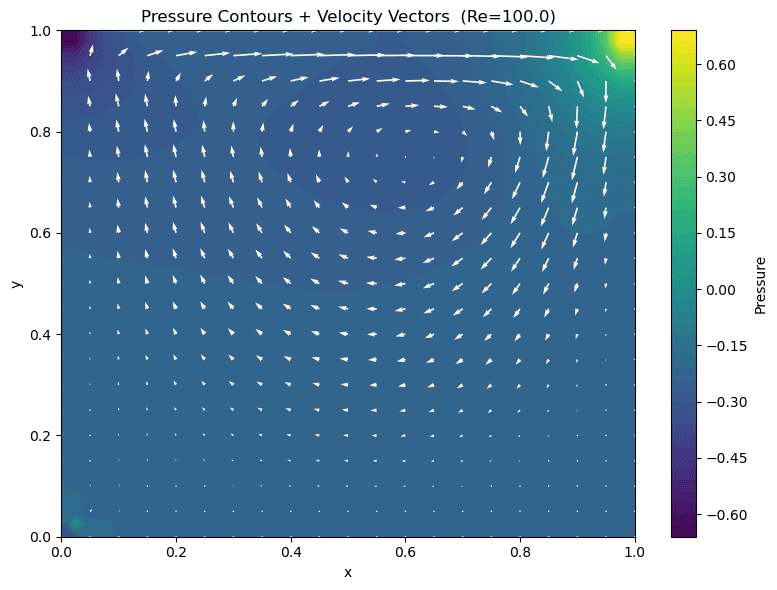
Lid-Driven Cavity Flow: A Python Projection Method Solver Validated Against Ghia et al. (1982)
I have been studying CFD (Computational Fluid Dynamics) from absolute basics like 1D Advection Flow, Diffusion Problems, Burgers Equation. I'm using Python to simulate and solve all these problems myself. From there I worked up to the Navier-Stokes Equation Problem and I studied about the Projection method to solve it. I built a custom solver to simulate the 2D incompressible viscous flow with Projection method. To verify the solver working correctly I chose to solve the Classic Lid-Driven Cavity Problem and compared my results against the Ghia et al. (1982) benchmark data to validate the solver.
Effects of Grid Arrangement and Convection-Scheme Discretisation on Projection-Method Accuracy for the Lid-Driven Cavity: A Verification Study
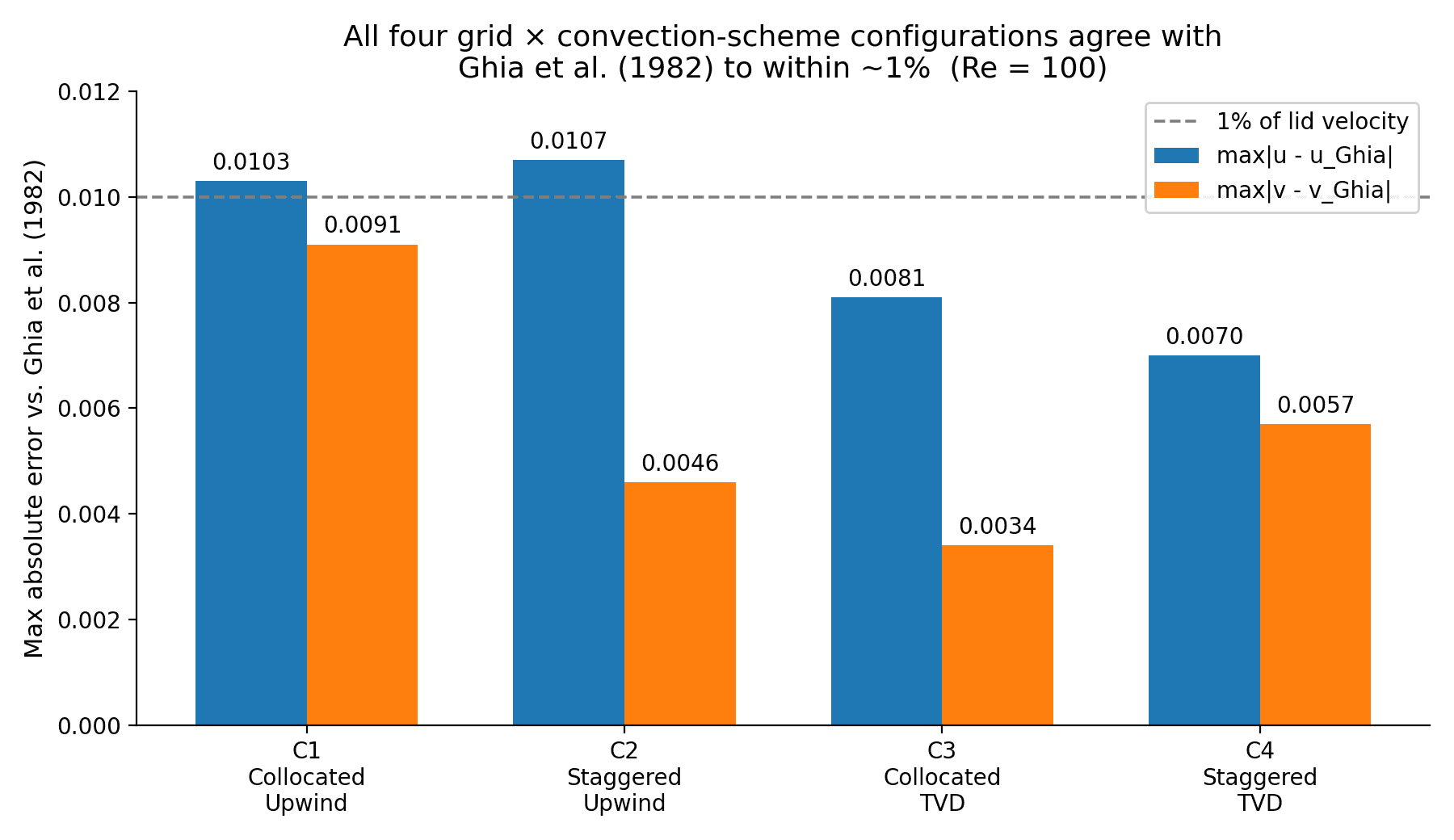
A systematic verification study isolating how much of a projection-method solver's accuracy comes from grid arrangement versus convection-scheme discretisation – something most published lid-driven cavity validations don't separate out. I ran a 2×2 comparison (collocated vs. staggered/MAC grid, crossed with first-order upwind vs. second-order TVD Van Leer convection) at Re = 100, validating all four variants against Ghia et al. (1982) using an identical quantitative error metric. All four configurations agree with the benchmark to within about 1% in both velocity components, with TVD improving on upwind in at least one component. A companion 1D screening study compares five convection schemes (upwind and four TVD limiters – minmod, Van Leer, superbee, MC) to give an a priori basis for choosing Van Leer. I also re-examined a collocated-grid TVD configuration I'd previously flagged for pressure-solver convergence difficulty, and found it converges cleanly – producing the lowest v-velocity error of all four configurations tested.