SIMPLE Algorithm
Lesson 2.5 of the CFD for Absolute Beginners course — SIMPLE Algorithm.
Lesson 2.5 — SIMPLE Algorithm
The Predictor-Corrector Idea
SIMPLE (Semi-Implicit Method for Pressure-Linked Equations, Patankar & Spalding, 1972) is a predictor-corrector approach:
- Predict a velocity field from momentum, using a guessed pressure .
- Correct the velocity and pressure so that continuity is satisfied.
The correction is derived by requiring . This leads to a Poisson equation for the pressure correction .
The SIMPLE Steps
Given :
Step 1 — Momentum predictor: solve momentum with (= on first iteration):
generally does not satisfy .
Step 2 — Pressure Poisson equation: write . Apply continuity:
Step 3 — Correction:
where is the pressure under-relaxation factor (typically 0.3).
Step 4 — Convergence check: compute the residuals. If converged, advance . If not, return to Step 1 with updated .
Under-Relaxation
SIMPLE is iterative and can diverge without damping. Under-relaxation factors and slow the updates:
Typical values: , . There is no universal rule — tuning is part of the art of CFD. Note: is a common guideline.
SIMPLE Variants
| Variant | Full name | Key difference |
|---|---|---|
| SIMPLE | Semi-Implicit Method for Pressure-Linked Equations | Original. Under-relaxation needed. |
| SIMPLEC | SIMPLE-Consistent | Improved correction, less under-relaxation needed |
| SIMPLER | SIMPLE-Revised | Solves full PPE, not just correction |
| PISO | Pressure-Implicit with Splitting of Operators | Two correction steps; used for unsteady flows |
OpenFOAM uses PISO by default for transient simulations and SIMPLE for steady-state.
import numpy as np
import matplotlib.pyplot as plt

def solve_poisson_jacobi(p, rhs, dx, dy, max_iter=50):
    """Iterative Poisson solver (Jacobi, fixed iterations)."""
    for _ in range(max_iter):
        p[1:-1, 1:-1] = (
            (p[1:-1, 2:] + p[1:-1, :-2]) / dx**2 +
            (p[2:, 1:-1] + p[:-2, 1:-1]) / dy**2 -
            rhs[1:-1, 1:-1]
        ) / (2/dx**2 + 2/dy**2)
        # Neumann BC
        p[0,:] = p[1,:]; p[-1,:] = p[-2,:]
        p[:,0] = p[:,1]; p[:,-1] = p[:,-2]
    p -= p.mean()
    return p

# Grid parameters
N     = 41
L     = 1.0
dx    = dy = L / (N - 1)
Re    = 100.0
nu    = 1.0 / Re
rho   = 1.0
dt    = 0.001
alpha_p = 0.1  # strong under-relaxation for stability

# Fields
u = np.zeros((N, N))
v = np.zeros((N, N))
p = np.zeros((N, N))

# Lid: top wall moves at u=1
u[-1, :] = 1.0

# Run a small number of outer iterations to show the SIMPLE loop structure
n_outer = 500
div_history = []

for outer in range(n_outer):
    u_star = u.copy()
    v_star = v.copy()

    # Momentum predictor (explicit Euler, simplified)
    # u-momentum
    u_star[1:-1, 1:-1] = (u[1:-1, 1:-1]
        - dt * (u[1:-1, 1:-1] * (u[1:-1, 1:-1] - u[1:-1, :-2]) / dx
              + v[1:-1, 1:-1] * (u[1:-1, 1:-1] - u[:-2, 1:-1]) / dy)
        - dt/rho * (p[1:-1, 2:] - p[1:-1, :-2]) / (2*dx)
        + dt * nu * ((u[1:-1, 2:] - 2*u[1:-1, 1:-1] + u[1:-1, :-2]) / dx**2
                   + (u[2:, 1:-1] - 2*u[1:-1, 1:-1] + u[:-2, 1:-1]) / dy**2))

    # v-momentum
    v_star[1:-1, 1:-1] = (v[1:-1, 1:-1]
        - dt * (u[1:-1, 1:-1] * (v[1:-1, 1:-1] - v[1:-1, :-2]) / dx
              + v[1:-1, 1:-1] * (v[1:-1, 1:-1] - v[:-2, 1:-1]) / dy)
        - dt/rho * (p[2:, 1:-1] - p[:-2, 1:-1]) / (2*dy)
        + dt * nu * ((v[1:-1, 2:] - 2*v[1:-1, 1:-1] + v[1:-1, :-2]) / dx**2
                   + (v[2:, 1:-1] - 2*v[1:-1, 1:-1] + v[:-2, 1:-1]) / dy**2))

    # Apply BCs to u*, v*
    u_star[0,:]=0; u_star[-1,:]=1.0; u_star[:,0]=0; u_star[:,-1]=0
    v_star[0,:]=0; v_star[-1,:]=0;   v_star[:,0]=0; v_star[:,-1]=0

    # Pressure Poisson — central differences so both terms give shape (N-2, N-2)
    div = (u_star[1:-1, 2:] - u_star[1:-1, :-2]) / (2*dx) + \
          (v_star[2:, 1:-1] - v_star[:-2, 1:-1]) / (2*dy)
    rhs_pp = np.zeros_like(p)
    rhs_pp[1:-1, 1:-1] = rho / dt * div

    p_prime = solve_poisson_jacobi(np.zeros_like(p), rhs_pp, dx, dy)

    # Correction
    u[1:-1, 1:-1] = u_star[1:-1, 1:-1] - dt/rho * (p_prime[1:-1, 2:] - p_prime[1:-1, :-2]) / (2*dx)
    v[1:-1, 1:-1] = v_star[1:-1, 1:-1] - dt/rho * (p_prime[2:, 1:-1] - p_prime[:-2, 1:-1]) / (2*dy)
    p += alpha_p * p_prime

    # Re-apply BCs
    u[0,:]=0; u[-1,:]=1.0; u[:,0]=0; u[:,-1]=0
    v[0,:]=0; v[-1,:]=0;   v[:,0]=0; v[:,-1]=0

    # Track divergence (same central-difference stencil)
    div_full = (u[1:-1, 2:] - u[1:-1, :-2]) / (2*dx) + (v[2:, 1:-1] - v[:-2, 1:-1]) / (2*dy)
    div_history.append(np.max(np.abs(div_full)))

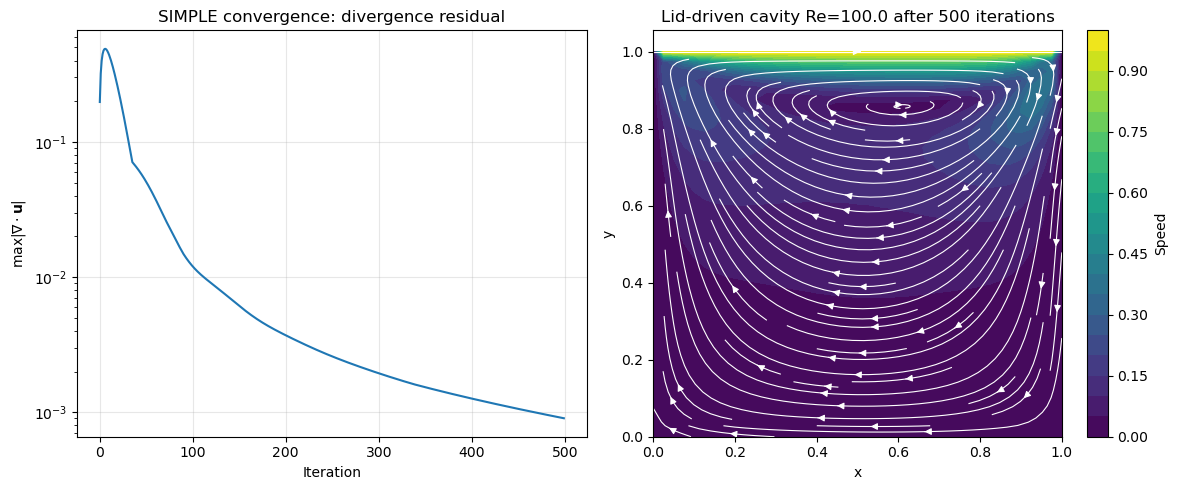
fig, axes = plt.subplots(1, 2, figsize=(12, 5))

axes[0].semilogy(div_history)
axes[0].set_xlabel('Iteration')
axes[0].set_ylabel('$\\max|\\nabla\\cdot\\mathbf{u}|$')
axes[0].set_title('SIMPLE convergence: divergence residual')
axes[0].grid(True, alpha=0.3)

x = np.linspace(0, L, N)
y = np.linspace(0, L, N)
X, Y = np.meshgrid(x, y)
speed = np.sqrt(u**2 + v**2)
cf = axes[1].contourf(X, Y, speed, levels=20, cmap='viridis')
plt.colorbar(cf, ax=axes[1], label='Speed')
axes[1].streamplot(X, Y, u, v, color='white', density=1.2, linewidth=0.8)
axes[1].set_title(f'Lid-driven cavity Re={Re} after {n_outer} iterations')
axes[1].set_xlabel('x'); axes[1].set_ylabel('y')

plt.tight_layout()
plt.show()
Key Takeaways
- SIMPLE decouples the N-S system into: (1) solve momentum → ; (2) solve PPE → ; (3) correct , .
- Under-relaxation is essential for stability: , .
- Convergence is measured by residuals: velocity residual + pressure (continuity) residual.
- SIMPLE is the foundation of ANSYS Fluent, OpenFOAM (simpleFoam), and many other codes.
- PISO (used in icoFoam) makes two correction steps per time step — better for unsteady flows.
Next: Lesson 2.6 — Lid-Driven Cavity: the "Hello World" of CFD, full implementation and validation.